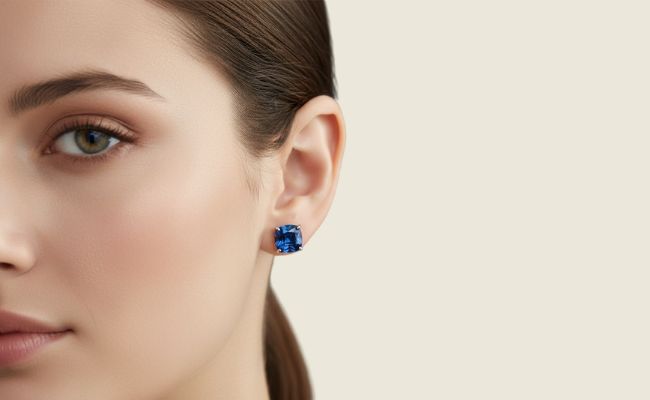

Aquamarine is the blue to blue-green variety of the mineral beryl, and it is the modern birthstone for March. Its colour comes from traces of iron within the crystal, ranging from a pale sky tint through to a deeper sea blue-green. At Irosk, aquamarine is set in 925 sterling silver across earrings, pendants, rings and bracelets, and every piece names its stone type on the product page so you know exactly what you are buying.
Aquamarine belongs to the beryl family, the same mineral group that produces emerald. The difference is the trace element responsible for the colour: iron gives beryl its blue and blue-green tones, while chromium and vanadium produce green emerald. The name comes from the Latin aqua marina, meaning sea water.
Natural aquamarine is a variety of beryl and sits at 7.5 to 8 on the Mohs hardness scale. That is hard enough for everyday wear in earrings and pendants, though like most faceted stones it can chip on a sharp knock against a hard surface.
Irosk sets both Created Aquamarine and Natural Aquamarine. These are not the same product and we do not describe them interchangeably.
Every Irosk product page lists the stone under a Stone heading in the specifications. If a piece is set with Created Aquamarine, it says so there. The gemological detail further down this page — inclusions, origin and carat pricing — describes natural aquamarine specifically, and should not be read as applying to created stones.
Most aquamarine on the market sits at the lighter end of this range. In natural stones, deeper and more saturated blues are scarcer and priced accordingly. Colour is the single biggest driver of natural aquamarine value — more so than size. A one-carat stone with a strong even blue can be worth more than a larger, paler one.
Because the tone is cool and light, aquamarine pairs naturally with the bright white of rhodium-plated sterling silver, which is how we set every piece in the range.
Aquamarine has a long association with the sea. Roman and Greek sailors were said to carry the stone on voyages in the belief that it would keep the waters calm, and it has traditionally been linked with steadiness, clarity of thought and honest communication. In the language of Victorian gift-giving it was associated with faithfulness.
These are traditions and beliefs rather than properties of the mineral. We describe them because they are part of why people choose the stone, not as claims about what it does. If you would like the fuller story, our article on aquamarine meaning and symbolism covers the history in more depth.
March is one of several months with more than one traditional birthstone. Alongside aquamarine, older birthstone lists name bloodstone — a dark green chalcedony flecked with red iron oxide, historically favoured for carved signet rings and seals. Aquamarine is the modern March birthstone and the one you will find in almost all contemporary jewellery.
Irosk does not stock bloodstone. Our entire March range is aquamarine, in sterling silver.
Our full aquamarine care guide goes into more detail on cleaning and long-term storage.
Everything in our aquamarine range is made in 925 sterling silver with rhodium plating, and arrives in a gift box with free express shipping across Australia.
If you are choosing a piece as a gift, our guides to choosing aquamarine jewellery and gift ideas for March birthdays are a good place to start. For the zodiac connection, see our Pisces birthstone guide.
Yes. Aquamarine is the modern birthstone for March. Bloodstone appears on older traditional lists as a second March stone, but aquamarine is the one used in contemporary birthstone jewellery.
Natural aquamarine is mined, and each stone varies slightly in tone and clarity. Created aquamarine is grown in a laboratory and gives a more even, consistent colour at a lower price. Irosk stocks both, and each product page names the stone type in its specifications.
Natural aquamarine is a beryl and rates 7.5 to 8 on the Mohs scale, which suits daily wear in earrings and pendants. Rings take more knocks than other pieces, so a protective setting such as a halo or bezel is worth considering for everyday use.
Written by the Irosk team. Irosk is a family-owned Australian jewellery brand based in Brisbane, working exclusively in 925 sterling silver. We describe every stone we sell by its correct name, and set out the difference between created and natural stones on each product page.